The Science of Sleeping Upright: What Happens to Your Neck on a Plane
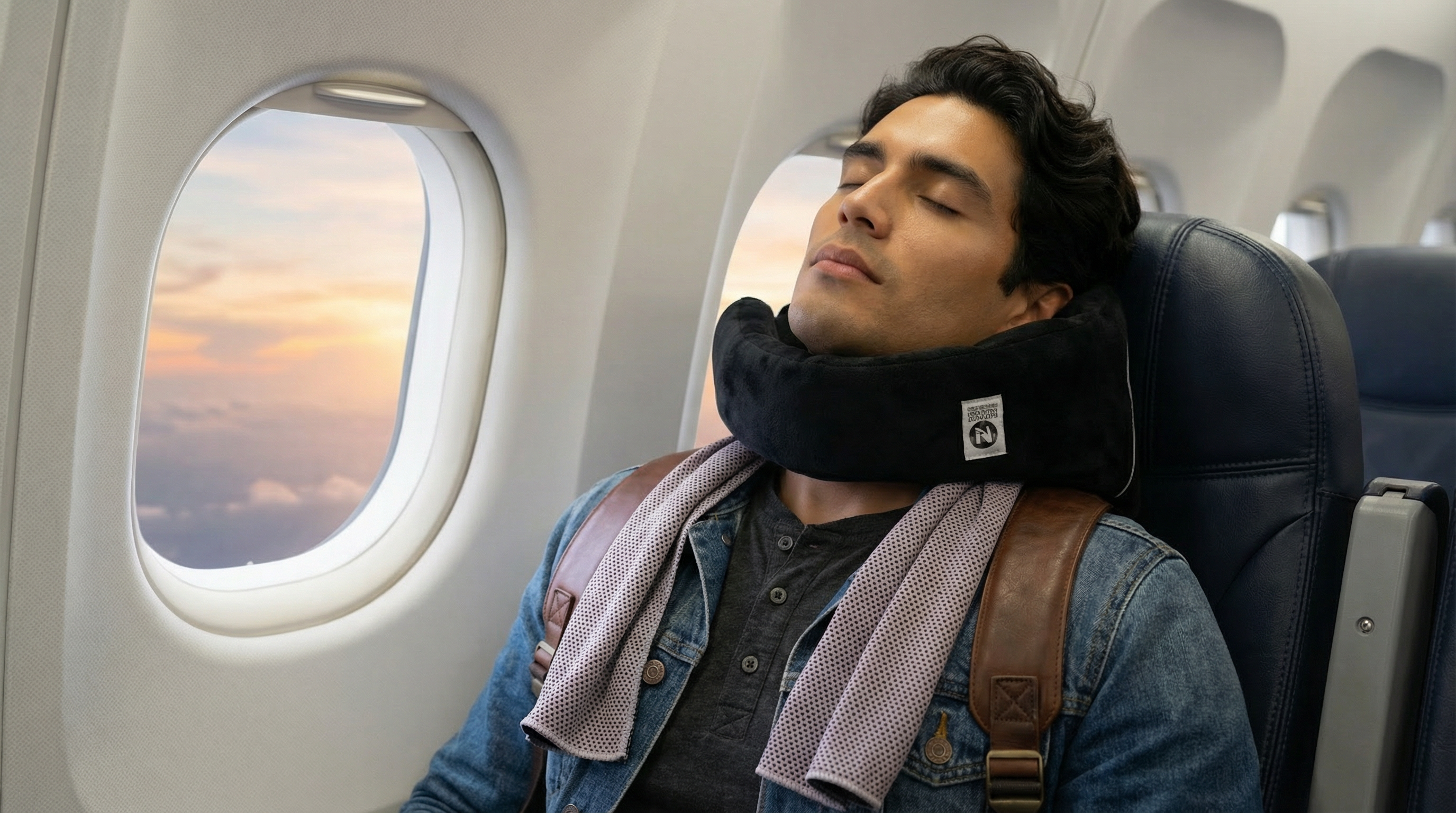
Your neck was not designed to sleep upright. Your bed gives your spine a neutral, horizontal rest. A plane seat asks the same spine to support an 11-pound head against gravity, for hours, while the muscles that normally do the work are trying to switch off.
That mismatch is why so many people land with a stiff neck, a dull headache, and the kind of fatigue that even three espressos cannot fix.
What your cervical spine is doing at 35,000 feet
Your cervical spine, the top seven vertebrae, has a natural forward curve called lordosis. When you stand or sit tall, that curve distributes the weight of your head evenly across the discs and joints.
The moment you fall asleep upright, that curve breaks down:
- Head drops forward, flattening the curve and loading the front of the discs.
- Head tips sideways, compressing one side of the cervical joints while overstretching the other.
- Neck muscles lose tone, so the soft tissues, ligaments and discs, carry weight they were not built to carry alone.
Hold that for six hours and you have done the cervical equivalent of doing yardwork with one arm.
Micro-arousals: the hidden tax of bad sleep
Even if you "slept" the whole flight, you probably did not. Without proper head support, your body wakes you up dozens of times per hour in events called micro-arousals, too short to remember, long enough to wreck your sleep architecture. You skip the deep stages where actual recovery happens.
That is why a "full night" on a plane often feels like no sleep at all.
Three biomechanical fixes
1. Keep your head in line with your shoulders
The single most important thing you can do mid-flight is prevent forward head-drop. Your pillow needs to support the front of your neck, not just the sides.
2. Reduce lateral tip
If your head leans hard left or right, you compress one side of your cervical spine for the entire sleep. A pillow that lets you choose your tilt angle, and locks it there, fixes this.
3. Soften the load on your shoulders
A pillow that bottoms out forces your shoulders to do the work. Look for a fill that resists compression for hours, not minutes.
Why this is the problem we set out to solve
Our adjustable travel pillow was engineered around the cervical science, not around what is easy to mass-produce. It locks into the angle you need, supports the front of the neck, and holds shape for the whole flight. Read the full design story.
Better sleep on a plane is not magic. It is biomechanics, and once you give your spine what it actually needs, the rest of the trip changes.
Explore More From Nodless
Every product from Nodless is built around one promise. Upgrading you to first class. Discover the Nodless Travel Pillow and full Nodless collection or read the story behind the brand on the Nodless about page.